Exhibits are created in four basic stages. In the interest of stoking the fire, I am detailing them here.
1. Concept Development (done!)
- Historical context and significance of the Joel S. Cotton, Jr. Collection, as demonstrated by the social biography of one artifact in the Collection.
- Exhibit Title Determined—From Maker to Museum: Weaving through a Collection
2. Design Development
- Publicity
- graphic design and production of publicity material (post card and flyer/poster)
- I would like to see each student choose 1 of their objects to be featured on the poster/postcard. I am hoping Michele will be able to at least help design this postcard. Each of you should decide (by this Wednesday) which of your objects you'd like to feature on the postcard/flyer.I'm thinking here of thumbnail size images that do NOT necessarily show the entire object, but perhaps a close-up of a particular weave or other attribute or even the old Cotton family label (what do you guys think?). The designer of the postcard can then figure out how to place those thumbnails so that they reference "a collection" or "weave through" the collection. (Michele--if this is just too far out, feel free to scale it back, should you decide to dive into this.)
- we need to get approval from the univ for the postcard design and acquire the parking permit code/stamp for opening day.
- dissemination of publicity materials via museum webpage, univ. PR office, and elsewhere
- get pdf. of flyer to Cristi Hunter to print posters on our large format printer.
- Exhibit Design
- NarrativeStructure
- I envision the featured artifact's journey (from maker to museum) as involving the following stages and basic discussions (with sidebars and other possibilities branching of from this):
- Production--including harvesting and preparation of materials, weaving (I assume it will be a basket but this isn't set in stone, I take it? We need to make this determination based on the story that the artifact can tell from make to museum; let's get this decided by this Friday at the latest! Read the accession file and Cotton notepad and suggest an object. Late this week I'll open a new post to allow us to centralize a final discussion, but talk amongst yourselves).
- Entrance into a sphere in which Joel S. Cotton, Jr. was able to acquire it (that is: it is commission by a dealer, or it is offered for sale by the weaver to either Cotton or to some other agent from whom Cotton purchased it (see his little catalog pad--he bought some things from a story in Berkeley). This area of the exhibit is the one in which the Cotton family pioneer history can/should be told.
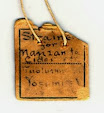
- Cotton integrates the object into his collection (assigning it a catalog number and making relevant notes on it's purchase, attribution, function, design, cost, etc.) Clearly the choice of object will either expand or limit the story you can tell here. I think Cotton's own labels (you can see these inside the actual objects) are especially important here. They materialize a significant stage in the social life of the object; his labels signify the movement of the object into a new cultural and commodity sphere. (Some of these may even be labels affixed while the baskets were on a store shelf--it is possible to do a bit of research on this). We can reproduce the page from Cotton's notepad that shows his data for the featured object, enlarge and mount it on foam core. Same with the original Cotton label--assuming it has one--and if it doesn't, you guys can still use other labels to help visitors SEE how Cotton organize and gave meaning to his collection (more ideas on this later; I don't mean to pre-empt your own creativity).
- Acquisition of object (and collection) by Sacramento State College in 1962. At this point, accession file materials are at your disposal (again, enlarged and spraymounted with didactics written by you all). NOTE: those of you who haven't yet opened the digitized accession folder on SacCT, please do this asap and read this material so that you can contribute to the exhibit design.
- First cataloging of object/Cotton Collection as property of the Anthropology Department/Museum (we have small 3x5 catalog cards with wonderful drawings by a former professor who was a student at the time he cataloged these objects and gave them the FIRST set of museum catalog numbers).
- Second cataloging of the object/collection, this time with prefixes that identify the material (the "BAS, FIB, BEA business--for basketry, fiber, beadwork, etc.) and entirely different suffix numbers. These catalog cards use photographs vs. drawings, and feature much more technical information. (I think they were produced about 15 or 20 years after the original SSC cards.) At any rate, these blue, 5 x 7" cards represent a second phase of museum life for the Cotton collection objects. Professional basket scholars were consulted re: cultural affilitations, etc. New numbers/tags are affixed to the objects, and so forth.
- The Cotton family requests appraisals for previously donated objects, and then Mrs. Cotton adds a couple more objects to the collection (this may not all have happened in one year or stage; has to be researched in the accession file).
- ANTH 196M students exhibit and research the featured object/collection for the purposes of NAGPRA inventory.
- Object moves in a couple hypothetical directions post-2010 (per discussion on some of your blogs).
- Interpretation/fleshing out of the various passages/life stages of the object and collection (as enumerated above--OR otherwise established by you guys) and development of interpretive text and graphics.
- Writing of Introductory Panel for entrance wall and Acknowledgments Panel for exit wall.
- Schematic(floor plan) & elevation (wall) design per previous bullet. I have uploaded a pdf of the gallery layout to SacCT for your convenience.
- Design of the open storage component. What logic will drive final placement/grouping of the objects in the glass cases? Will some of the objects have been integrated into the larger story as side-bars? Will the case objects have labels? How many levels of information will be delivered? Would you rather just use the catalog cards (as actual artifacts in and of themselves)?
- Development of Interpretive Teams (that incorporate both grads and undergrads) to do all of the aforementioned (or whatever variation you decide upon). I am more than happy to do this myself, but it makes sense for you all to get together and figure it out on your own. Those of you who aren't yet sure how your lab hours are supposed to get used, this is IT. These aren't extra-curricular hours, they are figured into the units you receive as course credit. I will help with whatever you need. Opening the museum for meetings, providing any feedback, etc.
I see the teams being assigned according to the following components of the exhibit's narrative structure. I believe this represents a fair split of the research and writing. Which team do you want to lead or work with? How will these teams become populated? Shall I let you all volunteer and then assign those who haven't chimed in or don't know what team to join? NOTE: on Friday, I am going to open a separate post to allow you all to let me know how this team-making process is panning out.
Team 1 (assigned solely to no. 1 [production of object])
Team 2 (assigned no.s 2 & 3--Joel S. Cotton context/ownership)
Team 3 (assigned no.s 4, 5, 6, & 7 University/Museum ownership)
Team 4 (assigned no.s 8 & 9; the contemporary context)
Team "Michele": photographer and graphic designer of exhibit postcard/flyer (?)
Team "Case Design": everyone, but with a couple leaders (this is not going to take the same amount of time as the other tasks)
3. Fabrication
- print, spraymount, and trim didactic text (everthing is "written and edited" in the design phase).
- print, spraymount and trim other graphic components (such as spraymounted enlargements of tags or photographs, or accession documents, or maps or the text of NAGPRA, etc.)
- develop/identify mounts for objects
- print labels for individual/case objects (if you decide to go that route).
- ordering and mounting exhibit title vinyl lettering (for entrance wall).
4. Installation
- mounting and placing the materials outlined under #3
- cleaning and locking the cases, windexing the cases, vacuuming, replacing tools, etc. (for this show, I don't see this as that much more work than concept development--but I've been wrong many times before!:)
CLEARLY, the design phase is the most work and we have entered it. By the next class meeting (at which Dr. Johnson will speak about the history of the collection) I hope you all will have read and thought about our timeline and how you can get together with one another to accomplish the necessary work. Also, in this post I am trying to provide structure (not dictate), so please do not read this and feel creatively confined. There is plenty of room for improvement in what I have envisioned here.




Correction: JSC purchased some objects from a STORE in Berkeley (not a story).
ReplyDeleteI would like to work on Team 1 Production of object or my second choice would be Team 2 Joel S. Cotton context/ownership. I also would like to suggest my basket (of course) BAS0098 74-32-2-33 McCloud Area Burden Basket, to be selected to follow its path from maker to museum. With just the little info I've read on it, I believe it has a significant story to tell. The thumbnails I suggest are #1 damaged burden basket (although may not show up well on postcard), #5 close up of rim and remnants of weaving of damaged burden basket, or #17 close up of woven design of BAS0164 74-32-2-37 burden basket. I will also post this info on my blog.
ReplyDeleteThanks for chiming in Mary. Just so you know--once you select your object for the postcard, I can take a photo of it (or any portion of it); you don't have to make use of the study photos on smugmug. But, I do love that redbud woven rim on the McCloud burden basket! Still, I'm not a photographer, and even if we produce a large postcard, I don't know how it will show up. We'll see what Michele and others say.
ReplyDeleteThis is a very detailed blog/description of the exhibit process [thanks, Dr. C, for writing it all out for us]. It provides the basic structure and wiggle-room for the creative process.
ReplyDeleteI'd be interested in Team2 and also working with Team-Michele [I have a some art-background and am interested in learning how it can be applied to design elements of the museum?]
[Would it be too much to join two teams?]
Will post a blog for which of my items will be featured on the postcard [I really like the idea for the design]
Miranda, you are welcome (and sorry for all the typos. I'd go in and correct them but blogger tends to lose bullet & outline formating in the "edit post" mode). I look forward to learning which of your object you'd like to show on the postcard. And yes, you may work on 2 teams (at least at some point in the process.)
ReplyDeleteI think I would be interested in team 1 and my second choice would be team 2, although they all sound interesting. Hard to chose!
ReplyDeleteWow, great post with so much info to take in! I think I would be most interested in team 2, with my second choice being team 3.
ReplyDeleteI would like to be a part of team 4 or team 2
ReplyDeleteDitto - appreciate all the detail you gave us for next steps! I'd like to be on Team 2 (maybe I'll find some good stuff in the Sacramento Room at the library). My personal opinion for postcard design is that fewer images are better, such as one striking image, up to 3. However, I'm good wth whatever Michele and the postcard team decide. Out of my 3 objects, I would go with a detail of the floral motif beadwork for my beaded bag BEA52. The colors are really nice.
ReplyDeleteTeam "Michele" agrees with her role and concurs.
ReplyDeleteThanks for all the great info. I would like to be added to Team 4. My focus as an Anthro major with a minor in Native Amercian Studies is to go on to JFK's MA program in Museum Studies with an emphasis on NAGPRA so Team 4 is exactly up my alley.
ReplyDeleteExcellent, all--your names have all been added to the requested team.
ReplyDeleteI can work wherever but I am good at manual labor!! so I can do 3 or 4.
ReplyDeleteThank you for organizing all of this. I wrote on my blog that I'd really like to work with team 2, but I'll write it again here. :)
ReplyDeleteJust a thought: It looks like there might be some descendants still around. If this is the case, maybe we should invite them to the exhibit?
I think I would like to be on team 4!
ReplyDeleteDuring the guest lecture, I realized I'd better get back on here and say never mind my comment about inviting any descendants to our exhibit.
ReplyDelete